by Daniel Clark
Quis custodiet ipsos custodes? Who will guard the guards themselves?
Now long detached from its original context, the phrase is evoked to conjure an elemental truth: those with power require scrutiny in order to ensure the exercise of that power is proportionate and just.
Judges, of course, have an awful lot of power. It is, however, an important constitutional safeguard on the exercise of their power that judges are still bound by the same laws as the rest of us. One exception is data protection law.
In this area, where an individual, court, or tribunal is acting in a judicial capacity, and is processing personal data, the UK[i] GDPR provisions do not apply. It is however an idea for the birds that that judges will never misprocess personal data: that they will never read an email in public or be indiscrete in a bar or forward an email to an unintended recipient.
So, who guards the guards? That is the role of the Judicial Data Protection Panel, founded in 2018 to investigate all complaints about the processing of personal data done by a person acting in a judicial capacity.
But who guards those guards? Ordinarily we would expect the question of who scrutinises a judicial panel to be answered by the public; a scrutiny achieved by public access to, and understanding of, its work. Not so for the Judicial Data Protection Panel, about whose work there appears to be scant information available. They do not publish reports, they do not hold public meetings. The only information about their ongoing work is a complaints handling policy document, a terms of reference document, and a couple of lines in the Lady Chief Justice’s annual report.
This blog post is about my attempts to find out more about the work of the Judicial Data Protection Panel. I ought to be honest from the start that I have been able to find out no more about this Panel than what is already publicly available. However, failing to receive any adequate information has revealed quite a lot.
Given the complexities of the issues in discussion, it is necessary for me to engage in quite a lot of exposition. The first section sets out the first relevant legislative framework – the Data Protection Act 2018 – as well as the publicly available information on the Judicial Data Protection Panel.
The second section examines another relevant legislative framework – the Freedom of Information Act 2000 – and the way in which the Judicial Office asserts itself as exempt from its terms.
Notwithstanding this assumed exemption, the third section then sets out in painstaking detail the results of my attempts to get further information about the Judicial Data Protection Panel via freedom of information requests. With retrospect, these requests were not always perfectly expressed. As you’ll see, however, that doesn’t really matter.
Data Protection and the Judicial Data Protection Panel
The Data Protection Act 2018 (henceforth DPA) makes provision for, inter alia, ‘the regulation of the processing of information relating to individuals’. It requires personal data to be processed fairly, and confers a right on a data subject (that is, the person whose data is being processed) ‘to obtain information about the processing of personal data and to require inaccurate personal data to be rectified’ (§2(1)(b)).
The DPA complements, and incorporates into UK domestic law, the EU General Data Protection Regulation (GDPR). There are seven GDPR principles which, taken together, set out the framework for how data should be processed. The processing of that data, and therefore to whom these principles apply, is done by a data processor. The data subject also has various rights.
The DPA also established, in its current form, the Information Commissioner’s Office (ICO) which can investigate allegations of, and if necessary penalties for, improper and unlawful processing of personal data. A high profile example of the ICO’s enforcement action is when it gave TikTok a £12.7m fine for its failure to enforce its age policies, and for not providing adequate information about how data was collected and used.
The law is not applied equally in this area; there are exemptions. Schedule 2 contains a list of exemptions, the most relevant (for my purposes) is at §14:
(2)The listed GDPR provisions do not apply to personal data processed by—
(a)an individual acting in a judicial capacity, or
(b)a court or tribunal acting in its judicial capacity.
Simply put, this means that a person whose personal data is processed by a member of the judiciary acting in their judicial capacity, or a court or tribunal, cannot obtain any information about how their personal data has been processed or request that inaccurate personal data is rectified. Furthermore, the ICO does not have jurisdiction over people who are acting in a judicial capacity.
The judiciary is not deaf to complaints about judicial processing of personal data and, in May 2018, the Judicial Data Protection Panel was established. The Panel investigates all complaints about the processing of personal data done by a person acting in a judicial capacity. It expressly will not uphold two types of complaints (see p3-4, the following bullet points are direct quotes).
- The first is that a copy of personal data processed by a court, tribunal or individual acting in a judicial capacity be provided to the individual whose personal data it is. The basis on which such requests are made is the right of access under Article 15 UK General Data Protection Regulation (UK GDPR) or section 45 Data Protection Act 2018 (DPA 2018). Such information is typically contained in judicial notes, notebooks, or electronic documents.
- The second is that a judgment or court order that contains personal data be corrected because it is said to contain incorrect personal data. The basis on which these requests are made is the right to rectification contained in Article 16 UK GDPR or section 46 DPA 2018.
I do not take the second bullet point to mean that the Panel will consider no complaints about judgments. Indeed, on p2 the complaints handling policy sets out complaints that can be dealt with by the Panel, which includes ‘writing or handing down judgments or orders’ as an example of acting in a judicial capacity (and therefore something the Panel can address).
The Panel is made up of three judges: Lord Justice Lewison (the Chair), Mr Justice Johnson, and Upper Tribunal Judge Wikeley. However, the Policy on dealing with complaints explains that only ‘complex complaints’ will be referred to the Panel (though it does not define complexity). All other complaints by the Judicial Office Data Privacy Officer or another individual within the Judicial Office.
There is precious little information in the public domain about the work of the Panel. The most recent public source we have located is the Lady Chief Justice’s (henceforth LCJ) 2026 report, in which three short paragraphs are dedicated to the Panel. These are reproduced below, alongside the LCJ’s report from 2025 and 2024.
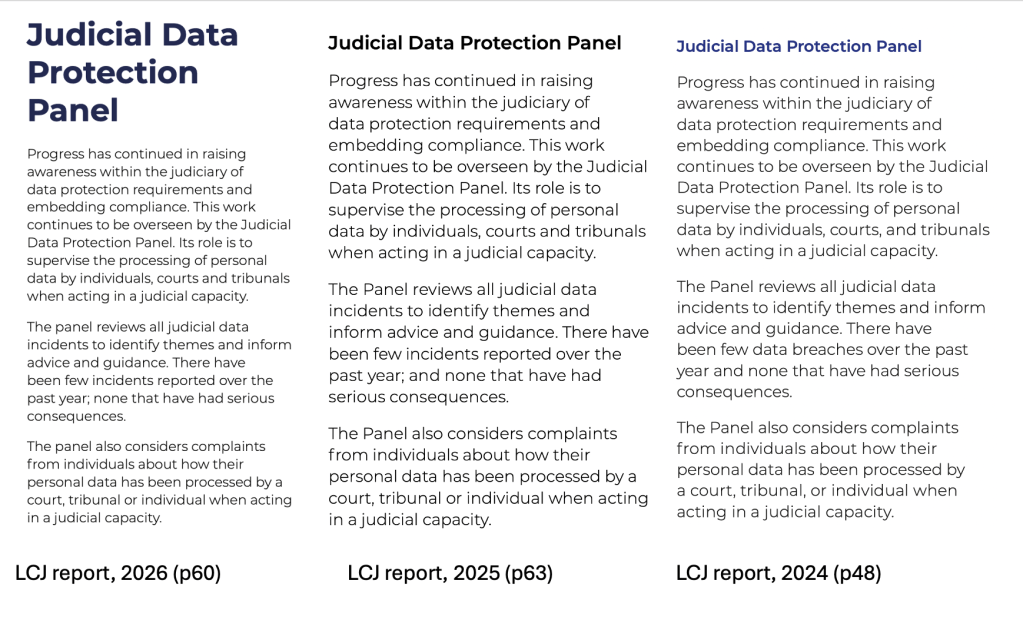
As can be seen, the phrasing of this section of the annual report is almost identical, save for a slight difference in grammar in the second sentence of the second paragraph. Across all three annual reports, only that sentence gives an insight into the work of the Panel: ‘there have been few incidents reported over the past year; none that have had serious consequences’.
Much like the reference to complexity in the Policy discussed above, “serious consequences” or “few” are not defined. As Robin Allen KC put it in a public LinkedIn post about this section of the LCJ’s 2026 report, ‘in my view any incident of judicial failure to comply with data protection is serious whatever the actual consequence’. I agree.
The judiciary is a large organisation, involving many hundreds of actors acting in a judicial capacity, and many thousands who come into contact with courts and tribunals every year. Frankly, with the best will in the world, mistakes happen: bear in mind, for example, that accidentally sending an email cc (that is, so all recipients can see each other’s email addressed), rather than bcc (where email addresses are hidden), or forwarding an email to the wrong person, constitutes misuse of personal data.
In Q4 (October to December) 2025, the ICO received 3,677 reports of data security incidents: a 16% increase from the same quarter in 2024 (note that any breach committed by someone acting in a judicial capacity need not be reported to the ICO). It nevertheless seems to me to be highly unlikely that there have been ‘few incidents’ involving those acting in a judicial capacity.
One possible explanation for all of this is that the LCJ’s report refers to solely the complaints that are passed on to the panel of three judges and excludes the work of the Judicial Office Data Privacy Officer. As there is no way of knowing for certain, I have proceeded on the assumption that the reference is to the work of both the judicial members of the Panel and that of civil servants in the Judicial Office.
To try and find out more, I made the decision to submit a Freedom of Information request. There was, however, a problem with this approach.
Freedom of Information and the Judicial Office
The explanatory note to the Freedom of Information Act 2000 (henceforth FOIA) explains that the Act makes ‘provision for the disclosure of information held by public authorities or by persons providing services for them’. Schedule 1 defines a public authority as, inter alia,
Any government department other than
(a)the Competition and Markets Authority,
(b)the Office for Standards in Education, Children’s Services and Skills.
The Judicial Office, in which the Judicial Data Protection Panel can be found, is an arms-length body of the Ministry of Justice. For the better part of two decades, the Judicial Office did accede to FOIA requests made to it (as I’ll demonstrate soon). In Gabriel Kanter-Webber v The Information Commissioner & Anor [2022] UKFTT 481 (GRC), the Tribunal received evidence from Amy Shaw (the then Deputy Director of Communications in the Judicial Office) that,
in the past, the Judicial Office has responded to FOIA requests made to it but confirms that its new approach is to take the view that it is not within the scope of FOIA because it is not listed in schedule 1 FOIA.
(para 29)
When or why this change in approach was made is not clear. The wider context makes it even more puzzling. According to the judgment, Kanter-Webber made his request (the details of which are irrelevant for my purposes) on 4 May 2021, and received a response that the Judicial Office is not a public authority (vis the FOIA) on 14 May 2021. So far so good.
However, I have discovered that a legal blogger (Daniel Cloake) made an FOI request to the Judicial Office on 30 November 2021. He received a response from the Judicial Office on 30 December 2021. Intriguingly, the response comes from the Judicial Office but describes the information as being held by the Ministry of Justice. This is relevant because of a problem the Tribunal had in the Kanter-Webber case.
Despite accepting the Judicial Office’s position (more on which shortly), the Tribunal expressed some reservations. It described itself as:
troubled by some confusing procedures and practices in this case, as follows. Given that the Judicial Office regards itself as a separate entity to the Ministry of Justice and so falling outside the ambit of FOIA, we were puzzled that the Ministry of Justice should have carried out the internal review of the Appellant’s request (para 34).
While the judgment in Kanter-Webber came second, the style of the response to Daniel Cloake is a good illustration of the problem (though I stress Daniel Cloake did not need to request an internal review so the carry across in that regard is limited).
Notwithstanding this problem, the Tribunal accepted ‘that the relationship between the Judicial Office and the Ministry of Justice exists within the context of the important constitutional principle of the separation of powers’ (para 31). They went on to say that:
we do not share the Appellant’s concern that the Ministry of Justice is seeking to avoid its responsibilities under FOIA by re-branding the Judicial Office as a separate sub-unit and declaring it to be exempt from FOIA. We accept that the exclusion of judicial information from FOIA was a conscious legislative choice by Parliament and our Decision in this appeal seeks to give effect to that choice.
(para 33)
Taken in the round, this means that the Judicial Office is not a public authority (in the meaning of Schedule 1 of the FOIA) and therefore is exempt from the terms of the FOIA. At this juncture it is worth noting that the UK Supreme Court does not consider itself exempt from the FOIA (apart from access to records or documents relating to proceedings as per section 32 of the FOIA[ii]) and even provides a simple online form for you to use.
So, why did I decide to submit an FOI request about the work of the Judicial Data Protection Panel? Surely this was a non-starter before I’d even typed out my questions, let alone sent them for consideration.
The reason is simple. In 2020, Paul Magrath on behalf of the Transparency Project submitted an FOI request asking about the work of the Panel. The initial response was one of rejection but, after a request for internal review on the basis that the information could be provided on a discretionary basis in the interests of transparency, that information was provided.
It’s quite remarkable that the response states,
No complaints have been self-referrals by an individual acting in a judicial capacity. Nor would the Panel expect to receive any such complaints. The panel can deal with complaints concerning the processing of personal data by the courts, tribunals and individuals acting in a judicial capacity. If the court, tribunal or individual is themselves unhappy about how they are processing personal data they can simply stop or change the processing.
As I have repeatedly stated throughout this blog, accidents happen. Furthermore, the suggestion that a data processor could simply change their processing is technically true, but every other organisation would surely require a referral to be made to their data protection team (or equivalent). Why would it be any different for those acting in a judicial capacity?
This may be the explanation – or more accurately justification – for the LCJ’s description of the Panel having ‘few’ incidents reported it. After all, if individual judicial office holders are expected to simply police themselves, there really would be no need to report an incident. That being said, this assertion sits uncomfortably alongside the fact that there is a data breach notification form for use by members of the judiciary which is referred to at p5 of the October 2025 AI Guidance for Judicial Office Holders.
I wanted to find out what, if anything, had changed since Paul Magrath made this initial request in 2020. Notwithstanding the above discussion on the scope of the FOIA, I was hopeful that the Judicial Office would once again provide this information on a discretionary basis.
FOI requests and the Judicial Data Protection Panel
My first FOI request was met with an outright rejection.
Having anticipated this, I wrote back with a request that the Judicial Office provide the information on a discretionary basis. After a further email, this was treated – with my consent – as a request for an internal review. Looking back, I perhaps ought to have pushed back and said that this was a different type of request. However, as anybody who has researched the courts system will know, and has been painfully clear to me this year, getting a response from one person working in the Ministry of Justice or HMCTS is difficult. Sometimes you have to play with the hand you’ve been dealt.
The response – another rejection – came a few weeks later.
Recall here the Tribunal’s concern in Kanter-Webber that, ‘given that the Judicial Office regards itself as a separate entity to the Ministry of Justice and so falling outside the ambit of FOIA, we were puzzled that the Ministry of Justice should have carried out the internal review of the Appellant’s request’ (para 34).
I rather imagine the Tribunal would be puzzled by the fact that, some four years after that case, the Ministry of Justice is still carrying out an internal review on behalf of the Judicial Office. Perception matters, and the perception here is that the Judicial Office is separate from the Ministry of Justice until it wants to delegate work to it.
Irrespective of this problem, I decided to give up at this point. Given the state of the case law, I felt there was no real point in making a complaint to the Information Commissioner. I do have my reservations that the Tribunal’s conclusion in Kanter-Webber was a proper interpretation of the statutory scheme: the Judicial Office is, after all, part of the Ministry of Justice and staffed by civil servants. The fact is that I simply do not have the time or resources to pursue such a complaint to the Tribunal, especially not in circumstances where I’d want to challenge the conclusion of a previous judgment.
I therefore decided to pursue this with the National Archives, as had been suggested to me by the Ministry of Justice. However, I felt that some of the information I requested was obviously not going to be held by them. Why, for example, would the National Archives hold information as to how many complaints were made about the inappropriate use of AI? I therefore decided to only pursue my question in relation to how many judgments had to be ‘withdrawn or reissued by The National Archives Find Case Law service as a result of the original judgment containing personal data that should not have been available in a published judgment’.
Pausing here, some readers will recall that the Panel excludes from its remit complaints regarding a refusal to correct an order or judgment that is said to contain incorrect personal data. My request was about something different: not incorrect data but data that ought not to have been published in the first place. I know, both from my own experience and in discussions with others, that sometimes judgments are published that contain information that should not be published; for example, in breach of a reporting restriction.
The response from the National Archives was fairly quick and I reproduce it below (unlike the responses from the MoJ, the text was embedded in an email rather than in pdf):
I can confirm that The National Archives does not hold the information you have requested. While we can tell you that the number of judgments updated since the Find Case Law service launched in April 2022 is approximately 2,441 [from Jira], we are unable to tell you why as we do not routinely receive this information. We are not responsible for the content of judgments, or for deciding what should be redacted for publication, and courts and tribunals can revise or unpublish their judgments at any time and without explanation to us.
The National Archives preserves the judgments we receive and publishes them on behalf of the relevant court or tribunal. We do not redact or alter the texts. In addition, judgments are largely exempt from the requirements of data protection law, and we advise service users that any concerns about personal data in judgments be addressed to the court or tribunal that delivered the judgment.
You may find the following page useful in explaining the publication of personal data within the court judgments and tribunal decisions: https://caselaw.nationalarchives.gov.uk/privacy-notice#section-personal.
You may also find the following page useful in detailing the publishing policy for court judgments and tribunal decisions: https://caselaw.nationalarchives.gov.uk/publishing-policy.
If you are dissatisfied with the handling of your request or the decision which has been reached, you have the right to ask for an internal review. Internal review requests must be submitted within two months of the date of this response and should be addressed to:
[…]
Two things stand out here. The first is that, even as an approximate number, 2,441 is a high number of judgments: far more than I expected. The second flows from the first: that there appears to be no accountability mechanism in relation to why these judgments are updated. Some of them will have been updated under the slip rule (e.g. when a judge is alerted to a typographic error). But I know at least one contained information that should never have been published. Was that referred to the Judicial Data Protection Panel? And how many more are there?
It seems we’ll never know.
Conclusions
This research has been deeply troubling.
Every single person in this country is a data subject. Any one of us can become involved in the courts and tribunals system. We could be called to give evidence; we could be called to sit as a juror; we could be accused of a crime; we could be treated badly by our employer.
In the course of any one of those events, and much else besides, our data may be inappropriately processed. What happens then? Frankly, save for a brief policy document, we don’t know. The irony, of course, is that we could be in court because we have fallen foul of the DPA, the judge could by their action during the trial also fall foul of the DPA, but only one of us will be held publicly accountable.
Quis custodiet ipsos custodes?
Well, we know who: that was never in doubt.
We just don’t know how.
The Judicial Office did not respond to a request for comment.
I am grateful to the six people who assisted me with the research for, and provided comment on a draft of, this blog. I also wish to express my thanks to Paul Magrath, who was happy for me to see the FOI he made in 2020 and also gave me permission to reproduce it here.
[i] The same exemption can be found in equivalent schemes across the EU.
[ii] This exemption has been confirmed as applicable by the Information Commissioner: see IC-372876-H0F2 (this is also cited on the Supreme Court’s webpage on Freedom of Information, as linked in main text).


Leave a Reply